By Colin B., published November 12, 2026, last reviewed November 12, 2026By Colin B., updated Nov 12, 2026We earn a commission if you buy through our links. How this works
Croissants, pain au chocolat and danishes all come from the same trick: folding a slab of cold butter into dough again and again until you have dozens of thin layers. It takes patience and a cold fridge more than special gear. Here's the butter to buy, the few tools that matter, and how to control temperature.
00
The short version
Starter budget
$90 to $175
How hard
Takes real practice
Day one
Buy European-style butter with at least 82 percent butterfat and check you have a flat fridge shelf.
Look for European-style butter with 82 percent butterfat or more, such as Plugra, Kerrygold or President. It has less water, stays pliable when cold and makes flakier layers. Regular American butter (around 80 percent) is more likely to crack or leak during folding.
Clear fridge space first.
Laminated dough spends most of its life resting cold between folds. You need a flat shelf big enough for a half sheet pan, and ideally a cool kitchen. In summer, work early in the morning.
Plan for two or three days.
Most home croissant schedules mix the dough on day one, laminate on day two, and shape, proof and bake on day two or three. The hands-on time is only about an hour, but it can't be rushed.
02
Rolling pins and rulers
Lamination is about rolling dough to an even thickness without squeezing the butter out. A straight, heavy dowel pin applies even pressure across its whole length, which is why most pastry chefs prefer it to tapered or handled pins. A ruler matters more than people expect: recipes give exact rectangle sizes, and square corners and even thickness are what make clean, even layers.
Best starter$32.99as of Nov 12, 2026★★★★★ our ratingIn Stock
J.K. Adams
Maple Wood Dowel Rolling Pin, 19 x 2 Inch
A solid maple dowel made in Vermont. It's long enough to roll a croissant sheet in one pass and heavy enough that you let the pin do the work instead of pressing down. No handles to get in the way. About $33. 1,600+ reviews at 4.7 stars.
A similar straight maple pin from a pastry supply brand, made in Canada, for about a third of the price. Lighter than the J.K. Adams, but plenty for home batches. Sold by Amazon. About $12. 380+ reviews at 4.7 stars.
A stainless steel ruler with a cork back that doesn't slide on a floured counter. Use it to measure rectangles, square up edges, and mark even triangles for cutting. Wash it like any utensil. About $10. 60 reviews at 4.6 stars.
A bench scraper lifts sticky dough, squares off edges and cleans the counter between folds. A sharp wheel cuts clean edges for triangles and squares. A dull knife drags and seals the layers shut, which stops them rising. A soft natural-bristle brush applies a thin, even egg wash without deflating proofed pastry, which silicone brushes struggle with.
Best starter$14.97as of Nov 19, 2026★★★★★ our ratingIn Stock
OXO
Good Grips Multi-Purpose Scraper and Chopper
A stainless bench scraper with a grippy handle and a ruler printed on the blade. You'll use it every few minutes: lifting dough, squaring sides, cutting the butter block and scraping the counter. Sold by Amazon. About $15. 19,000+ reviews at 4.8 stars.
A stainless wheel with a straight edge on one end and a fluted edge on the other. Rolls clean cuts through laminated dough without dragging, which keeps the layers open. Sold by Amazon. About $11. 5,200+ reviews at 4.7 stars.
A wide, soft natural-bristle brush that lays down a thin, even coat of egg wash for that deep, glossy croissant color. Soft enough not to dent proofed dough. About $13. 160+ reviews at 4.4 stars.
Temperature is the whole game. The butter block and the dough need to be equally firm when you fold: around 55 to 60F for the butter. Too cold and the butter shatters into chunks; too warm and it melts into the dough. Proofing needs warmth without melting the butter, usually 75 to 80F. A thermometer takes the guessing out of every step.
Best starter$16.99as of Nov 12, 2026★★★★★ our ratingIn Stock
Etekcity
Infrared Thermometer Temperature Gun 774
Point it at the butter block or the dough and read the surface temperature instantly, without poking holes. The fastest way to know whether you're ready to fold or need another 20 minutes in the fridge. Sold by Amazon. About $17. 48,000+ reviews at 4.6 stars.
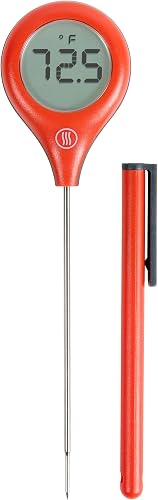
A probe thermometer for the core temperature of your dough after mixing, and for water when you activate yeast. ThermoWorks makes some of the most trusted kitchen thermometers. About $47. 1,100+ reviews at 4.6 stars.
A folding proofing box that holds a steady temperature you choose, so croissants proof at 75 to 78F every time, whatever your kitchen is doing. It folds flat for storage and doubles for sourdough and yogurt. About $249. 1,400+ reviews at 4.8 stars.
Croissant recipes are written by weight, and lamination leaves little margin for error, so a scale is essential. Bake on heavy aluminum half sheet pans, which brown evenly and don't warp at high heat. Precut parchment saves fighting with a roll every time. Croissants leak butter as they bake, which is normal, and parchment catches it.
Best starter$25.00as of Nov 19, 2026★★★★★ our ratingIn Stock
Escali
Primo Digital Food Scale
A simple, reliable kitchen scale that reads to 1 gram up to 11 pounds, with a tare button and a big display. The scale most bakers recommend for a first purchase. Sold by Amazon. About $25. 7,400+ reviews at 4.6 stars.
We like
1 gram precision
Simple and durable
Sold by Amazon
Know this
Not precise enough for tiny yeast amounts under a gram
Heavy uncoated aluminum half sheets, made in the USA, with a steel-reinforced rim that resists warping in a hot oven. Two pans let you bake one tray while the next proofs. Sold by Amazon. About $35. 35,000+ reviews at 4.7 stars.
Flat precut sheets that fit a half sheet pan exactly, so they lie flat instead of curling. They catch leaking butter and make cleanup easy. 220 sheets last a long time. About $15. 8,900+ reviews at 4.7 stars.
Your first croissants will probably leak butter and look a little lopsided. That's fine. Each batch teaches one thing: temperature, then lamination, then proofing. Here's how to get from a flat, bready first try to a shatteringly flaky third batch.
Croissants have a reputation for being difficult, and they’re demanding, but they’re not mysterious. Almost every failure comes back to one of three things: butter that was too cold or too warm, rushed rests, or an underproofed tray. Treat each of your first three batches as a lesson in one of them.
Pick one well-tested recipe with weights and stick with it across all three batches, so you can see what you changed.
A weekend schedule
Most home recipes fit a two-day rhythm:
Day 1, evening: mix the dough (10 minutes), then refrigerate overnight. Make the butter block and chill it too.
Day 2, morning: laminate with rests in between (about 2 to 3 hours, mostly waiting). Shape, then proof for 2 to 3 hours.
Day 2, afternoon: egg wash and bake.
You can also shape on day two, refrigerate the shaped croissants overnight, and proof and bake on day three for breakfast.
Batch 1: Temperature
The butter block and the dough need to be the same firmness when you fold: cold but bendable. Butter around 55 to 60F bends without cracking. Check both with a thermometer before every fold.
If the butter cracks into shards when you roll, it’s too cold; let the dough sit at room temperature for five minutes. If butter squishes out the edges or the dough feels greasy, it’s too warm; back to the fridge for 20 minutes. Your only job this batch is to notice these two feelings.
Don’t worry about the result. Even a messy first batch tastes good.
Now focus on technique. Lock the butter into the dough so it’s completely enclosed. Roll in one direction, from the center outward, with even pressure. Keep corners square and use a ruler to hit the dimensions your recipe gives.
For a letter fold, fold one third over the middle, then the other third on top. Rotate the dough 90 degrees before the next roll so you’re always rolling along the open edges. Rest it in the fridge for 30 minutes or more between folds, wrapped so it doesn’t dry out.
When you cut the dough, look at the edge. You should see clear, separate lines of butter. If you see streaks or patches, the butter melted or broke.
Batch 3: Shaping and proofing
Cut tall, narrow triangles with a sharp wheel, never a dull knife, which seals the layers. Stretch each one gently, then roll from the wide end with light pressure, keeping the tip underneath. Space them well apart on parchment.
Proof warm but not hot, ideally 75 to 78F. Above 80F the butter starts to melt. Proofed croissants look puffy, show visible layers on the sides and jiggle when you shake the tray. This usually takes 2 to 3 hours, often longer than the recipe says. Underproofing is the most common reason butter pools on the tray in the oven.
Egg wash gently with a soft brush, then bake hot until deep golden brown, darker than feels comfortable. Pale croissants are underbaked inside.
Cut one open. An open honeycomb inside with thin, crisp walls means it worked. From here, the same dough makes pain au chocolat, almond croissants and danishes, and every batch gets a little easier.
Bake one test croissant before the full tray to check proof and oven temperature.
Cut a baked croissant in half and look at the crumb. Open honeycomb means good lamination.
09
What it costs
Budget start
$90
Typical
$175
A dowel rolling pin, a bench scraper, an infrared thermometer and a kitchen scale come to about $90. Add a ruler, a pastry wheel, a brush, two half sheet pans and parchment and you're near $175. A proofing box is a later upgrade.
10
Common questions
Why is butter leaking out of my croissants in the oven?
Usually they were underproofed or proofed too warm. Underproofed croissants push butter out as they bake, and proofing above about 80F melts the butter inside the dough. Proof at 75 to 78F until they're puffy and jiggle when you shake the tray.
Why are my layers not visible?
The butter either melted into the dough or broke into pieces. Keep the butter and dough at the same firmness, rest the dough in the fridge between folds, and roll with steady, even pressure. A dull knife can also seal the edges shut.
How many folds should I do?
Most home recipes use three letter folds, or one book fold followed by one letter fold. More folds aren't better: too many layers become so thin they merge, and you lose that open, airy crumb.
Can I make croissants without a stand mixer?
Yes. Croissant dough is mixed only briefly, since lamination develops the gluten. A few minutes of kneading by hand is enough. Overmixing actually makes the dough harder to roll.
Can I freeze croissants?
Yes, and it's a great way to bake fresh on a weekday. Freeze shaped, unproofed croissants on a tray, then bag them. Thaw overnight in the fridge, proof in the morning and bake. Baked croissants also freeze well and reheat in a hot oven.
 Just Beginning