By Colin B., published November 16, 2026, last reviewed November 16, 2026By Colin B., updated Nov 16, 2026We earn a commission if you buy through our links. How this works
Composting turns kitchen scraps and yard waste into rich soil for your garden, and it mostly runs itself once you get the mix right. Here's how a tumbler, an open bin and a DIY pallet bin compare, the greens and browns ratio, hot vs cold composting, when a thermometer and aerator help, and what can and can't go in.
00
The short version
Starter budget
$105 to $225
How hard
Easy to start
Day one
Pick a level, shaded spot near the garden and set up your bin or tumbler.
Tumblers keep compost tidy and animal-proof and are easy to turn, but hold less and can stay too wet. Open bins hold more, sit on the soil so worms move in, and are cheap. A DIY pallet bin is free and huge, ideal for lots of leaves and yard waste. Many people end up with a tumbler for kitchen scraps and a big bin for leaves.
Balance greens and browns.
Greens (food scraps, coffee grounds, fresh grass) bring nitrogen and moisture. Browns (dry leaves, cardboard, straw, newspaper) bring carbon and air. Aim for about two to three parts browns to one part greens by volume. A smelly, slimy pile needs browns; a dry pile that won't break down needs greens and water.
Know what stays out.
Skip meat, fish, dairy, oils and pet waste in a home pile. They smell and attract pests. Skip diseased plants and weeds with seeds unless your pile gets truly hot. Glossy paper and plastic-coated cardboard don't break down.
02
Bins
An open bin sits on bare soil, so worms and microbes move in from below. It holds far more than a tumbler and is the cheapest way to compost a yard's worth of leaves and clippings. Expandable mesh bins can be opened to turn or harvest. Closed bins with lids keep rain off and look neater in a small yard, but are harder to turn. Put any bin on a level, shaded spot.
Best starter$35.99as of Nov 16, 2026★★★★★ our ratingIn Stock
Geobin
Expandable Compost Bin, 246 Gallon
A big, cheap open bin made of perforated plastic that you bend into a ring and pin closed. Expand it as your pile grows, and unclip it to turn or harvest. Made in the USA. About $36. 5,500+ reviews at 4.4 stars.
A closed black bin with a lid and a bottom door for harvesting finished compost. It keeps rain off, heats in the sun and looks tidy in a small yard. About $70. 3,000+ reviews at 4.5 stars.
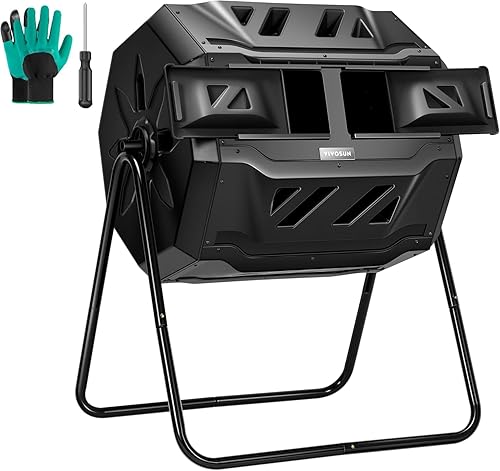
A tumbler is a drum on a stand that you rotate to mix the compost. Turning takes seconds, the drum keeps out rats and dogs, and it can sit on a patio. Dual-chamber tumblers let one batch finish while you fill the other side, which solves the biggest tumbler problem. They hold less than an open bin and can get soggy, so add plenty of browns.
Best starter$79.99as of Nov 16, 2026★★★★★ our ratingIn Stock
A two-chamber tumbler on a steel stand, so you can fill one side while the other finishes. Sliding doors and air vents on each chamber, and it turns easily when full. About $80. 9,900+ reviews at 4.3 stars.
A popular single-drum tumbler made in Canada from recycled plastic, with a simple crank-free turning design and vents. A good fit for a small household's kitchen scraps. About $70. 18,000+ reviews at 4.5 stars across this listing.
Air keeps compost working and stops it smelling sour, so you'll turn the pile every week or two. A garden fork moves material in an open bin. A compost aerator plunges in and twists to open air channels without moving the whole pile, which is easier in a closed bin. A long compost thermometer shows whether the center is hot, which tells you when to turn and when the pile is done.
Best starter$23.99as of Nov 16, 2026★★★★★ our ratingIn Stock
REOTEMP
20 Inch Backyard Compost Thermometer
A 20-inch stainless probe with a dial that shows active, hot and cooling zones, long enough to reach the center of a home pile. It comes with a simple composting guide. About $24. 3,400+ reviews at 4.7 stars.
A corkscrew-style aerator you crank into the pile and pull back out, opening air channels without forking the whole heap. Especially handy in closed bins. About $88. 510+ reviews at 4.8 stars.
A lidded kitchen pail by the sink makes composting a habit: scrape scraps in during the day and empty it every few days. A charcoal filter in the lid keeps smells in. When a batch is finished, a sifting screen separates fine compost for potting mixes and seed starting from the lumps, which go back into the active pile. Rough compost is fine for mulching beds.
A stainless kitchen pail with a handle, a tight lid and a charcoal filter to keep odors in. It holds a few days of scraps for most households and looks fine on a counter. About $25. 20,000+ reviews at 4.5 stars.
A framed screen with handles that sits over a wheelbarrow. Shovel compost on and shake: fine compost falls through, lumps stay on top. Also works for soil and rocks. About $37. 1,200+ reviews at 4.6 stars.
Compost is just greens, browns, air and water in the right mix. Here's a season-long plan: set up a bin, learn the ratio, keep it moist and turned, take its temperature, and sift your first batch of finished compost.
A compost pile that smells bad or never seems to break down almost always has one of three problems: too many greens, too little air, or the wrong amount of water. All three are easy to fix.
Week 1: Spot and bin
Choose a level, well-drained spot that’s easy to reach from the kitchen and the garden, with some shade so it doesn’t dry out. Set the bin directly on soil if you can, so worms and microbes can move in. A tumbler can sit on a patio.
Put a kitchen pail by the sink for scraps, and start saving browns: dry leaves, shredded cardboard, newspaper and straw. You’ll need more browns than you think.
Aim for roughly two to three parts browns to one part greens by volume. Greens are kitchen scraps, coffee grounds and fresh grass clippings. Browns are dry, carbon-rich material. Add them in layers, chop big pieces, and bury fresh scraps under browns to keep flies and smells away.
Keep the pile as damp as a wrung-out sponge. Squeeze a handful: a few drops is right. Too dry, add water. Too wet and smelly, add browns.
Turn the pile every week or two with a fork or aerator, or spin a tumbler every few days. Oxygen keeps the good microbes working and stops the sour smell. A compost thermometer shows when the pile is working: a hot pile reaches 130 to 160F in the center, which breaks things down fast and kills many weed seeds. A cool pile still works, just more slowly.
Compost is ready when it’s dark, crumbly and smells like a forest floor, and you can’t recognize what went in. Stop adding to one batch and let it rest a few weeks to cure. Then sift it through a screen and return the lumps to the active pile. Spread finished compost on garden beds, mix it into potting soil, or top-dress your lawn.
Start the pile with a layer of browns, then add scraps and cover them with more browns.
Do the squeeze test: a handful should feel like a wrung-out sponge.
09
What it costs
Budget start
$105
Typical
$225
A Geobin, a Utopia kitchen pail, a Reotemp thermometer and a Truper fork come to about $105. Swap the Geobin for a VIVOSUN dual-chamber tumbler and add a compost aerator and a sifter screen and you're near $225.
10
Common questions
How long does compost take?
A hot, well-turned pile can finish in two to three months in warm weather. A cold pile that you just add to and leave takes six months to a year. Tumblers often finish batches in six to eight weeks if the mix and moisture are right.
Why does my compost smell?
A rotten or sour smell means too many greens, too much water or not enough air. Mix in dry browns like leaves or shredded cardboard, turn the pile, and cover fresh scraps. Finished compost smells earthy.
Will compost attract rats?
Not if you keep meat, dairy, oils and cooked food out, bury scraps under browns, and use a closed bin or tumbler. In areas with rats, a tumbler or a bin with a hardware cloth floor is the safest choice.
Do I need a compost thermometer?
No, but it tells you whether the pile is working. A hot pile reaches 130 to 160F in the center within days of building it, and the temperature drop tells you when to turn it. It's especially useful if you want to kill weed seeds.
Can I compost in winter?
Yes. Activity slows in the cold, but you can keep adding scraps all winter. The pile will heat back up in spring. A larger pile and a tumbler in the sun stay warmer.
 Just Beginning